
Of all the diet strategies that come and go, “eat more protein” is one of the few that has quietly held up to scrutiny. It is not a branded plan, there is nothing to buy into, and it does not ask you to cut out entire food groups. Yet the evidence that protein helps with fat loss is surprisingly consistent — provided you understand what it actually does, and are honest about the size of the effect.
This guide walks through why protein works, how much you really need, where to find it affordably in the UK, and the genuine risks worth knowing about. The headline to hold onto is that a higher-protein diet is a useful tool rather than a magic bullet: it makes a calorie deficit easier to sustain and protects the muscle that keeps your metabolism ticking over. It does not override the basic maths of energy balance.
Why protein helps with fat loss
High-protein eating supports fat loss through three distinct, well-studied mechanisms. None of them is dramatic on its own, but together they tilt the odds in your favour.
1. It costs more energy to digest
Protein has a significantly higher thermic effect of food — the energy your body spends digesting and processing a nutrient — than either carbohydrate or fat:
| Nutrient | Thermic effect (energy cost to process) |
|---|---|
| Protein | 20–30% of calories consumed |
| Carbohydrate | 5–10% |
| Fat | 0–3% |
In plain terms, eating 100 kcal of protein “costs” your body around 25 kcal to process, compared with about 7 kcal for carbohydrate and just 2 kcal for fat. Research reviewed by Cambridge University found that protein intake causes an acute rise in diet-induced energy expenditure and, sustained over several days, even nudges up sleeping metabolic rate. The catch, which we will return to, is that in real numbers this only amounts to roughly 50 to 100 extra calories a day.
2. It keeps you fuller for longer
This is arguably protein’s most valuable trick. A higher protein intake increases the appetite-suppressing hormones your gut releases — GLP-1, CCK and PYY — while lowering ghrelin, the hormone that drives hunger. The net effect is that you tend to eat less without consciously trying.
In feeding trials where people were allowed to eat freely, higher-protein diets were associated with lower total daily calorie intake. In other words, simply making protein a bigger share of your plate can lead to a spontaneous, effortless reduction in how much you eat overall — no calorie counting required.
3. It protects your muscle
When you are in a calorie deficit, your body does not only burn fat — it also breaks down muscle for fuel. That matters because muscle is metabolically active tissue that helps determine how many calories you burn at rest. Lose too much of it and your metabolism slows, which is one of the main reasons weight loss stalls and rebounds.
Higher protein intake helps preserve this fat-free mass. A meta-analysis comparing higher- and lower-protein diets at similar calorie deficits found that the higher-protein groups achieved around 0.79 kg more weight loss, 0.87 kg more fat loss, and crucially 0.43 kg more lean mass preserved. The weight-loss difference is modest, but preserving muscle is what makes a result last.
The real power of protein is not that it melts fat. It is that it makes a calorie deficit easier to stick to, and protects the muscle that keeps your metabolism working for you.
How much protein do you actually need?
More is not endlessly better, and the right target depends on your goal. Here is a practical guide:
| Goal | Daily protein target |
|---|---|
| Standard weight loss (fat reduction) | 0.8–1.0 g per kg of body weight |
| Weight loss with muscle preservation | 1.2–1.6 g per kg of body weight |
| Resistance training plus fat loss | 1.6–2.2 g per kg of body weight |
For context, a 75 kg person aiming to lose fat while holding onto muscle would target roughly 90 to 120 g of protein a day. The UK NHS Eatwell Guide recommends only about 0.75 g/kg/day as a minimum — perfectly adequate for general health, but likely on the low side for optimal body-composition change while you are cutting calories.
The evidence is fairly clear on the thresholds: around 0.8 g/kg/day is enough to support weight loss, but roughly 1.2 g/kg/day is where muscle preservation and a sustained resting metabolism kick in. Intakes below 1.0 g/kg/day are associated with muscle loss during dieting, while more than about 1.3 g/kg/day, paired with training, can support muscle growth.
Getting enough protein on a UK budget
A common objection is that high-protein eating is expensive. It can be, if you lean on salmon and lean steak — but it absolutely does not have to be. Some of the best value protein sources are ordinary supermarket staples:
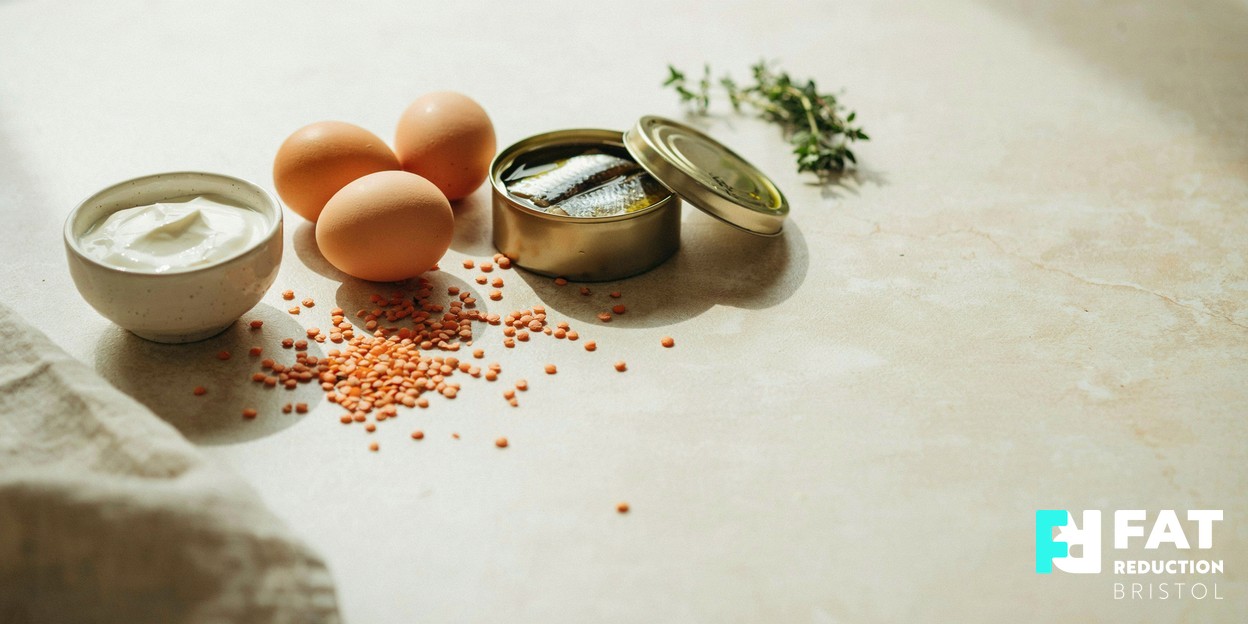
- Dried red lentils — around 24 g of protein per 100 g dry, and the best-value plant protein you can buy
- Tinned tuna and sardines — roughly 22–25 g per tin, no cooking required, with sardines adding omega-3s
- Eggs — a complete protein at a few pence each
- Frozen chicken breast — buying frozen can cut the cost by around 30 percent
- Skimmed milk and 0% Greek yoghurt — cheap, versatile and high in satiety
- Cottage cheese — underrated, filling and inexpensive
To put numbers on it, it is realistic to reach around 133 g of protein in a single day for roughly £2.64 using UK supermarket basics — think a few eggs, a tin of tuna, 200 g of chicken breast, some Greek yoghurt and skimmed milk. Whey protein powder is efficient and cheap per gram too, though it is ultra-processed and best treated as a convenient top-up rather than a foundation.
Protein, muscle and body composition
Here is where high-protein eating connects to the bigger picture of how your body actually looks. Fat loss and muscle are two sides of the same coin: the scales tell you your weight, but your body composition — the ratio of fat to lean tissue — is what shapes your silhouette and drives your metabolism. Protecting muscle while you lose fat is the difference between simply becoming a smaller version of yourself and genuinely improving your shape.
Protein supplies the building blocks, but muscle responds to a stimulus — and that stimulus is exercise, particularly resistance training. Eating more protein while sedentary mainly preserves what you already have; to actually build and tone muscle you need to load it. This is the same principle behind muscle-focused body-contouring treatments such as EMSculpt, which uses electromagnetic stimulation to contract muscle intensively — and which, like protein, works with your body’s composition rather than just the number on the scales. You can read more about that approach in our guide to EMSculpt for building muscle and burning fat. The shared philosophy is simple: sustainable results come from preserving and building lean tissue, not just shedding weight.
The honest risks and limitations
An evidence-based guide has to be balanced, so here is the other side.
Kidney health is the most clinically relevant concern. For people with healthy kidneys, trials lasting up to two years generally show little to no adverse effect on kidney function, though some observational data hints that very high intakes may accelerate decline over time. The real caution applies to people with existing kidney disease or risk factors such as diabetes, high blood pressure or obesity, where high protein intake is linked to faster loss of kidney function. If that describes you, keep intake moderate — roughly 1.0–1.4 g/kg/day, favouring plant and fish sources — and talk to your GP first.
Other considerations worth flagging:
- Digestion: increasing protein without keeping fibre up can cause constipation, so keep vegetables, wholegrains and pulses on the plate
- Nutrient gaps: very high-protein, low-carbohydrate versions can crowd out fruit and veg and leave you short on micronutrients
- Source matters: relying on red and processed meat raises cardiovascular risk — this is about the type of protein, not protein itself
- Cost: premium animal proteins can push up your food bill, though, as above, they are avoidable
And a dose of realism about the size of the effect. The benefit over a standard diet is genuine but modest — that extra ~0.79 kg of weight loss and ~0.43 kg of muscle preserved is meaningful over months, not overnight. Most of the advantage comes from better appetite control and spontaneous calorie reduction, not metabolic magic. Long-term adherence is also challenging: social meals and cultural norms make sustaining a very high-protein diet difficult for many people. The best target is the one you can actually keep to.
Where a high-protein diet fits
Think of protein as one reliable lever among several. It pairs naturally with other sustainable approaches — the Mediterranean diet for weight loss offers a whole-food framework that is easy to make protein-forward, and some people combine higher protein with structured eating windows, as covered in our look at intermittent fasting for fat loss. There is no single winning diet; there is the pattern of eating you can sustain while staying in a modest calorie deficit.
A note on body contouring
Diet and training are the foundation of any change in your body — no treatment replaces them. But once your weight is stable and you have done the work of preserving muscle, some people find that specific, stubborn areas simply will not shift. That is where non-surgical body contouring comes in, as a refinement rather than a substitute. If you have reached that point and want an honest assessment of whether treatments like muscle-building EMSculpt or fat-reducing fat freezing could complement the work you have already put in, book a consultation with the team at Fat Reduction Bristol. We will look at your goals, be straight with you about what is realistic, and help you build on the strong foundation that good nutrition gives you.
Pros & Cons
Pros
- Improves satiety and can reduce overall calorie intake without deliberate dieting
- Helps preserve lean muscle during a calorie deficit, protecting your metabolism
- Flexible, sustainable and achievable on a budget with everyday UK supermarket foods
Cons
- The measurable benefit over a standard diet is real but modest, not a shortcut
- Very high intakes can strain the kidneys in people with existing risk factors
- Requires attention to fibre and vegetables to avoid constipation and nutrient gaps
Frequently Asked Questions
How much protein do I actually need to lose fat?
For general fat loss, roughly 0.8 to 1.0 g of protein per kilogram of body weight per day is a reasonable target. If you also want to preserve muscle while dieting, aim higher — around 1.2 to 1.6 g/kg/day. People combining fat loss with resistance training may benefit from 1.6 to 2.2 g/kg/day. For a 75 kg person wanting fat loss with muscle preservation, that works out at roughly 90 to 120 g of protein a day.
Is a high-protein diet bad for your kidneys?
For people with healthy kidneys, short-term trials generally show little to no harm. The concern is real for people with existing kidney disease or risk factors such as diabetes, high blood pressure or obesity, where higher protein intake is linked to faster decline in kidney function. If that applies to you, speak to your GP before increasing protein significantly, and keep intake moderate.
Does protein really boost your metabolism?
Modestly, yes. Protein has a higher thermic effect than carbohydrate or fat, meaning your body burns more energy digesting it — around 20 to 30 percent of the calories consumed, versus 5 to 10 percent for carbs and almost nothing for fat. In practice this adds up to roughly 50 to 100 extra calories a day. It is a genuine effect, but a small one; most of protein's benefit comes from appetite control and muscle preservation.
Can I get enough protein on a budget?
Absolutely. Some of the best-value protein sources are cheap UK staples — dried red lentils, tinned tuna and sardines, eggs, frozen chicken breast, skimmed milk and Greek yoghurt. It is entirely possible to hit well over 130 g of protein in a day for a few pounds using ordinary supermarket foods.
Will eating more protein build muscle on its own?
Protein provides the raw material, but muscle is built by the stimulus of exercise — particularly resistance training. Eating more protein while sedentary mainly helps preserve the muscle you have during weight loss rather than adding new muscle. To actually build tone and strength you need to pair adequate protein with regular loading of the muscles.