
Fat-dissolving injections have become one of the most talked-about non-surgical body treatments, and Aqualyx is the name that comes up most often in UK clinics. The promise is appealing: a small pocket of stubborn fat, a course of injections, and a more refined contour without surgery. But the marketing rarely explains what is actually being injected, how it works, or what results are genuinely realistic — and that vagueness leaves a lot of people unsure what they are signing up for.
This guide walks through exactly what Aqualyx is, how it breaks down fat, what a course involves, what it costs in the UK, and who it does and does not suit. First, one crucial clarification: Aqualyx is an in-clinic aesthetic injectable for body contouring, not a weight-loss drug. It is completely distinct from prescription weight-loss injections such as Mounjaro or Wegovy, which work on appetite across your whole body. Aqualyx does one thing — it dissolves fat cells in a small, targeted area.
What is Aqualyx?
Aqualyx is an injectable fat-dissolving treatment developed in Italy by Professor Pasquale Motolese and commercially available since 2009. In Europe it is classified as a Class IIa medical device, CE-marked since 2012, and it is MHRA-approved in the UK. Notably, it is the only injectable fat-reduction treatment licensed across the EU for localised fat reduction, and it is sold exclusively to trained doctors and nurses — not something you should ever encounter at a discount or from an unregulated source.
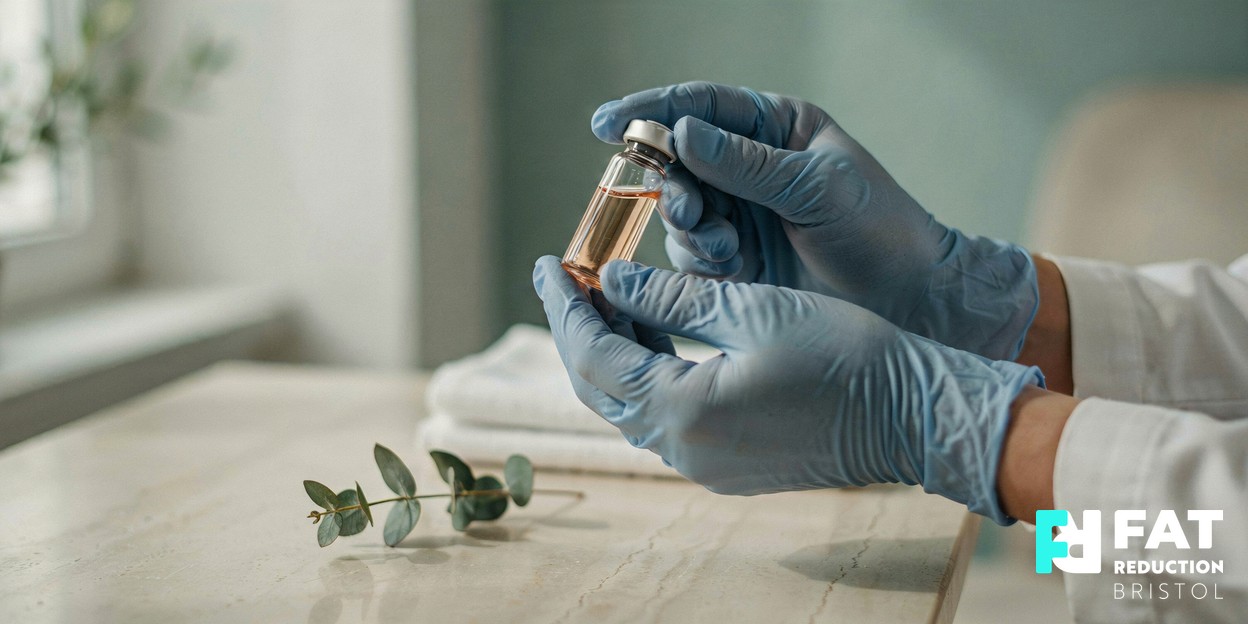
The active ingredient is sodium deoxycholate, a salt of deoxycholic acid. Deoxycholic acid is a secondary bile acid your own liver naturally produces to emulsify dietary fat in the gut. Aqualyx delivers it in an aqueous, micro-gelatinous gel matrix with buffering agents and a galactose-based polymer — a slow-release formulation designed to be gentler on the tissue than pure deoxycholic acid.
How Aqualyx works
The treatment relies on a process called adipocytolysis — the chemical destruction of fat cells. In plain terms, the steps are:
- The solution is injected directly into the subcutaneous fat layer using a fine 23–25G needle, in a fan-like retrograde pattern across the target pocket.
- The sodium deoxycholate acts as a detergent, disrupting the fat cell membranes by dissolving the lipid bilayer that holds them together.
- The fat cell membrane ruptures, releasing its lipid contents into the surrounding tissue.
- Your immune system responds: macrophages and inflammatory cells move into the area to clear away the membrane fragments and free lipids.
- Through fibroblast recruitment, the process stimulates neocollagenesis — new collagen production — which can provide a mild skin-tightening effect. This is one genuine advantage over purely mechanical fat-reduction methods.
- The processed fat is finally eliminated via the lymphatic system over the following weeks.
Aqualyx does not “melt” fat on the day. It chemically breaks open the fat cells, then relies on your own body to clear the debris away over the following weeks — which is exactly why swelling is part of the process and results take time to appear.
That slow, immune-driven clearance is why nothing visible happens immediately, and why the inflammation and swelling you feel afterwards are a sign the treatment is doing its job rather than something going wrong.
Which areas can Aqualyx treat?
One of Aqualyx’s main advantages is versatility. Unlike its US counterpart Kybella (known as Belkyra in Europe), which is licensed only for the area under the chin, Aqualyx is approved for use across multiple body areas:
| Area | Notes |
|---|---|
| Chin / submental fat | The classic “double chin” — the most precise small-area use |
| Jowls | Refining jawline definition |
| Abdomen | Upper and lower stomach; larger areas need more product |
| Flanks / love handles | A popular and well-suited area |
| Thighs | Inner, outer and “saddlebag” fat |
| Upper arms | The so-called “bingo wings” |
| Knees | Inner-knee fat pockets |
| Back | Bra-strap area and lower back |
It is best suited to small to moderate, well-defined deposits rather than large, diffuse areas — which is where surface-device treatments sometimes fit better.
What the evidence says
Aqualyx has a reasonable body of clinical support behind it. A 2020 clinical study showed significant reductions in subcutaneous fat thickness in more than 70 percent of participants, with visible improvements three to six weeks after each session. A UK clinical practice summary reports that two to four sessions, spaced four to six weeks apart, typically yield a 20–30 percent fat-volume reduction in the targeted area, and UK clinics report patient satisfaction rates of 85 to 92 percent after a full course.
It is worth being honest about what those numbers mean. A 20–30 percent reduction in a small pocket is a subtle refinement, not a dramatic transformation — and the marked immune response that clears the fat is the same process that causes the swelling. Managing expectations is a core part of a good consultation.
How many sessions, and how long results last
A typical course runs to two to eight sessions, spaced four to six weeks apart. Small areas such as the chin or knees usually need two to four sessions; larger areas such as the abdomen or thighs may need four to eight. Results begin to appear three to six weeks after each session as your body clears the treated fat.
Because the destroyed fat cells do not regenerate, the result is considered permanent. The important caveat is that neighbouring, untreated fat cells can still expand if you gain weight, so a stable weight is what protects your outcome. If your weight stays steady, a secondary course 12 to 18 months later can refine the result further.
What it costs in the UK
Aqualyx is priced per session and per area, so the total depends on how many areas you treat and how large they are. As a rough guide for 2025:
| Area / format | Typical UK price |
|---|---|
| Chin / face area | £350–£399 per session |
| Small body area (introductory) | £99–£200 per session |
| Medium body area (around 15×10 cm) | £150–£200 per session |
| Larger body area (around 20×15 cm) | £225–£300 per session |
| Full course across multiple areas | £400–£800 total |
At Fat Reduction Bristol, Aqualyx body areas are priced from £99 promotionally up to around £300 depending on the size of the area. Premium London clinics can charge from £399 for the face up to £599 per session for the body. As always, choosing a properly trained medical practitioner using genuine, pharmacy-sourced product matters far more than chasing the lowest headline price.
Is Aqualyx right for you?
The ideal candidate is an adult at or near their ideal weight with a small to moderate, localised pocket of fat that has resisted diet and exercise — a double chin, flanks, inner thighs or knees, for example. It suits people who want targeted contouring and prefer an injectable approach over surface-device treatments.

Aqualyx is not suitable for everyone. It is generally avoided if you have:
- Lipodystrophy
- A compromised immune system, including Type 1 diabetes
- Pregnancy or breastfeeding
- Active infection or skin inflammation in the treatment area
- Blood-clotting disorders, or if you take anticoagulants
- Severe liver or kidney disease
- A history of keloid scarring (a relative contraindication)
A proper consultation exists precisely to check these things and to be honest about whether the treatment will do what you are hoping.
Risks and side effects
For most people, side effects are temporary but can be more noticeable than with device-based treatments. The most common are:
- Swelling — reported in around 88.7 percent of patients, and often pronounced for three to five days
- Bruising — around 72.5 percent of patients
- Redness and tenderness at the injection sites
- Temporary numbness — around 16.3 percent of patients
Less commonly, small nodules can form under the skin; these are typically self-limiting and resolve within four to six months. Rare risks include hyperpigmentation, infection (usually linked to poor technique or non-pharmaceutical-grade product), and — very rarely, and only with incorrect technique — skin or nerve damage. This is exactly why Aqualyx should only ever be administered by a trained medical professional using product ordered from a UK pharmacy.
A quick word of caution on cheaper alternatives: non-approved products such as “Lemon Bottle” lack MHRA approval and CE marking. Aqualyx retains a clear advantage in regulated, published safety data, and that regulatory track record is a large part of what you are paying for.
How it compares to other non-surgical options
Aqualyx is one of several non-surgical body-contouring routes, and it is not automatically the best choice for every concern. It excels at small, precise pockets — the chin, jowls and knees especially. For larger, softer areas, other approaches may suit you better. Fat freezing uses controlled cooling to reduce broader pinchable pockets without needles, and we cover it fully in our fat freezing guide. Ultrasound cavitation uses sound waves to disrupt fat across larger, softer areas, as explained in our ultrasound cavitation guide.
It is also worth being realistic about the bigger picture: none of these treatments is a substitute for a stable, healthy weight. If your stomach is your main concern, our guide to losing stubborn belly fat is a good place to start before considering any in-clinic treatment. Body contouring works best as a finishing touch, not a shortcut.
Ready to find out if Aqualyx suits you?
If you have a small, stubborn pocket of fat that will not shift no matter how consistent you are, Aqualyx fat-dissolving injections may be a genuinely useful option — but the only way to know for sure is a proper assessment. A consultation lets us look at the area, talk through realistic results, check that the treatment is safe for you, and recommend the approach most likely to give you the outcome you want. Book a consultation with the team at Fat Reduction Bristol and we will give you an honest answer, whether that is Aqualyx or something better suited to you.
Pros & Cons
Pros
- Targets small, precise pockets of fat — double chin, jowls, flanks and knees — that resist diet and exercise
- Destroys fat cells permanently, and the mild collagen-stimulating effect can add subtle skin tightening
- The only injectable fat-reduction treatment licensed across the EU, sold exclusively to trained medical professionals
Cons
- It is body contouring, not weight loss, and only suits localised deposits in people near their ideal weight
- Swelling and bruising are common and can be pronounced for several days after each session
- A full course of two to eight sessions is usually needed, spaced four to six weeks apart
Frequently Asked Questions
Is Aqualyx the same as weight-loss injections like Mounjaro or Wegovy?
No, and this is an important distinction. Aqualyx is an in-clinic fat-dissolving injectable made from sodium deoxycholate, injected directly into a small pocket of fat to break down the cells locally. It is a body-contouring treatment, not a weight-loss drug. GLP-1 weight-loss injections such as Mounjaro and Wegovy are prescription-only medicines that work on appetite and blood sugar across your whole body. They are entirely different treatments for entirely different goals.
How many sessions of Aqualyx will I need?
Most people need between two and eight sessions, spaced four to six weeks apart. Small areas such as the chin or knees often need two to four sessions, while larger areas like the abdomen or thighs may need four to eight. Your practitioner will give you a realistic estimate at consultation based on the area and the amount of fat being treated.
When will I see results?
Nothing changes on the day. Visible improvement typically begins three to six weeks after each session as your body clears the treated fat through the lymphatic system, and results build across the full course. Patience is genuinely part of the treatment, and outcomes vary from person to person.
Are the results permanent?
The fat cells destroyed by Aqualyx do not grow back, so in that sense the result is permanent. However, the fat cells that remain in the area can still expand if you gain weight. Maintaining a stable weight protects your result, and a top-up course 12 to 18 months later can refine it further if needed.
Does Aqualyx hurt, and is there downtime?
Most people find it tolerable. You may feel stinging or a warm, burning sensation during and shortly after the injections, and the area is usually numbed with local anaesthetic first. Afterwards, swelling, bruising, redness and tenderness are common and can be pronounced for three to five days. There is no surgical downtime, but many people prefer to schedule sessions when they can allow the swelling to settle.